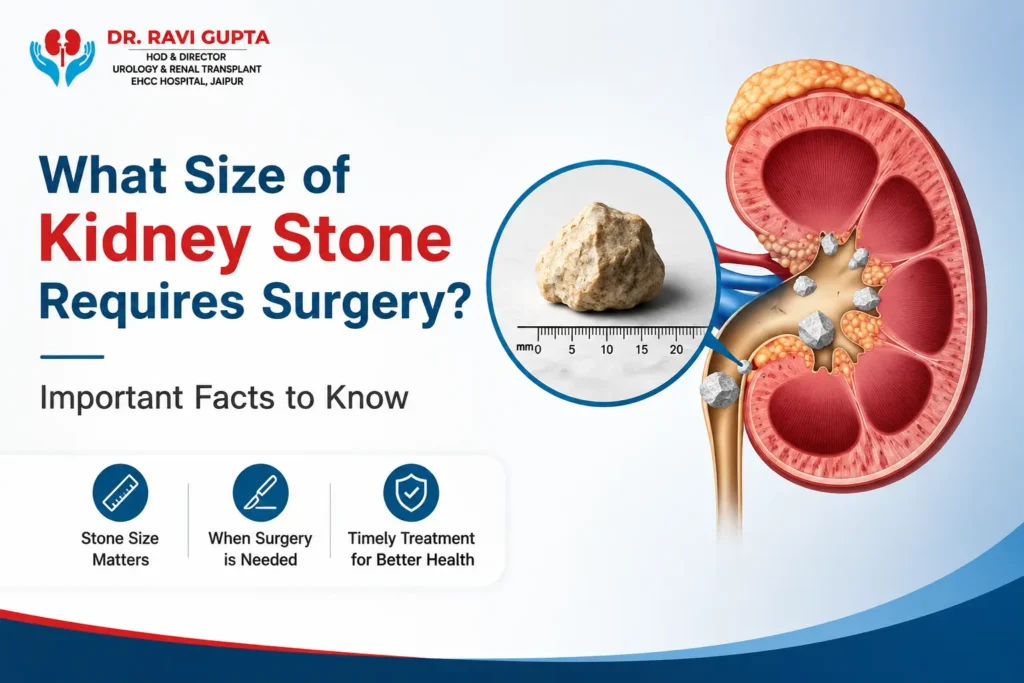
What Size of Kidney Stone Requires Surgery? Important Facts to Know
Kidney stones can be one of the most excruciating pains that can be felt. When a diagnosis of some sort has just been made, the first thing that often might occur to one’s mind is: Do I need surgery or can I do fine on my own?
What size of the kidney stone surgery is the most important factor in deciding whether or not to intervene. It’s important to know how the kidney stone removal size plays a part in treatment options, so you’re not as stressed and are better prepared for your consultation with your urologist.
Understanding Kidney Stone Sizes
How Kidney Stones Are Measured
Using imaging tests such as computed tomography (CT) or ultrasound, urologists are able to measure kidney stones in millimeters (mm). For example, the width of a standard pencil eraser is about 6mm and the width of a standard AAA battery is about 10mm. A stone can enjoy a smooth ride through the urinary tract or get stuck and cause a great deal of pain.
Kidney Stone Size Chart
| Kidney Stone Size | Chances of Passing Naturally | Recommended Treatment |
| Less than 4mm | ~80% to 90% | Hydration, pain management, and medical expulsive therapy (alpha-blockers). |
| 5mm to 6mm | ~50% | Watchful waiting, medications, or lithotripsy if pain is unmanageable. |
| 7mm to 9mm | ~20% | High likelihood of requiring minimally invasive surgical intervention. |
| 10mm to 20mm | Very Low (<5%) | Ureteroscopy or Shock Wave Lithotripsy. |
| Above 20mm | ~0% | Surgical intervention is required, typically via PCNL. |
What Size of Kidney Stone Usually Requires Surgery?
The size of the kidney stone that requires surgery can vary from person to person but there are guidelines to follow based on the diameter of the stone.
Stones Smaller Than 5mm
Stones less than 5mm in size are very likely to pass spontaneously. Physicians typically prescribe large amounts of fluids, pain medication and occasionally prescription alpha-blockers to loosen the muscles of the ureters.
6mm Kidney Stones
There’s a 6mm stone just on the edge. It has a 50/50 chance of passing without surgery. Your doctor may recommend waiting between a few weeks to check if it moves, if your pain is controlled and there is no sign of infection.
7mm to 9mm Kidney Stones
The chances of spontaneous passage at this stage are fairly low, about 20%. When such stones are present in the ureter, the internal diameter of which is only approximately 3mm to 4mm, it often lodges and results in painful episodes and necessitates modern medical treatment.
10mm Kidney Stones
A 10mm kidney stone is considered a “universal size” kidney stone. A stone of this size would be very difficult to pass through the narrow urinary tract safely. It is very likely that if you try to pass it on its own, you will completely block your urine flow.
Large Kidney Stones Above 20mm
Stones that are bigger than 20mm (2 centimeters) are referred to as “staghorn calculi” if they extend to the branches of the kidney and absolutely necessitate surgical extraction. They are too large to go into the ureter and can cause everlasting damage without being noticed.
Can a 7mm Kidney Stone Pass Naturally?
Although it can pass on its own occasionally, it is unusual for a 7mm stone to pass naturally when the person has a wider than normal urinary tract. Stone tends to become stuck at narrow structural connections. Patients with a 7mm stone will have continued renal colic (very strong, wave-like pain) and will ultimately need a doctor to break the stone up or remove it.
Does Kidney Stone Location Matter More Than Size?
Absolutely, there is no better way to plan a treatment than with location in mind.
Stones Inside the Kidney
Intact stones may not cause symptoms or damage even if they are 7mm or 8mm stones at rest in the kidney (calyceal stones). They are usually not operated on, but are monitored with periodic scans.
Stones in the Ureter
The ureters are long narrow tubes that run from the kidney to the bladder. If a 5mm stone gets into this small stone and becomes trapped, it will block the urine flow, resulting in severe pain and immediate removal is required.
Stones Near the Bladder
Once the stone reaches the lower part near the bladder, it’s passed the toughest “bottleneck. In some cases, even bigger stones can fall into the bladder and can be expelled during urination quite easily with a little help.
Symptoms That Mean You May Need Surgery Immediately
No matter how big the stone is, there are some warning signs that mean it’s time to stop waiting and it’s time to get to the OR:
- Inability to keep liquids down due to severe, unrelenting nausea and vomiting.
- Warm up the entire body, shaking chills or foul smelling urine, a high fever.
- Anuria (no urine) is a complete bilateral blockage or obstruction in a patient with only one kidney.
- Pain which persists despite the use of high doses of intravenous pain medication.
Best Treatment Options Based on Kidney Stone Size
Medicines and Natural Passage
For small stones, conservative management is best. Medications, such as tamsulosin, are used to relax the walls of the ureters so that it passes through less friction.
Shock Wave Lithotripsy (ESWL)
For stones that are less than 10mm and in the kidney or upper part of the ureter. High-energy acoustic shock waves are directed into the body from the outside to break it down into very small particles similar in size to sand grains, which you pass while peeing.
Ureteroscopy (URS)
Suitable for medium-sized stones (6mm – 15mm). A thin, illuminated scope is inserted into the urethra, bladder, and into the ureter. The surgeon finds the stone and places a small basket in it.
Laser Kidney Stone Surgery
If the stone is too big to break it up and remove it in one piece, a very accurate holmium laser fiber is pushed through the scope. This laser treatment for kidney stones crushes the stone into a fine powder, which causes less tissue damage.
PCNL Surgery for Large Stones
For stones more than 20mm, the standard treatment is Percutaneous Nephrolithotomy (PCNL). Your surgeon will make a very small one centimeter incision directly in your back and place a nephroscope into your kidney to fragment and suck out the stone fragments.
Open Surgery for Kidney Stones
As the technology of lasers and the laparoscope has developed, open surgery is extremely uncommon nowadays and is used for less than 1% of all extremely complex anatomical cases.
Kidney Stone Surgery Comparison Table
| Procedure | Best For | Recovery Time | Hospital Stay | Success Rate |
| ESWL (Shock Wave) | Small/medium kidney stones (<10mm) | 1 to 2 days | Daycare (No overnight stay) | 70% – 85% |
| Ureteroscopy (URS) / Laser | Mid-sized stones (6mm – 15mm) | 2 to 3 days | 0 to 1 day | 85% – 95% |
| PCNL (Keyhole Surgery) | Large/Staghorn stones (>20mm) | 1 to 2 weeks | 2 to 3 days | 90% – 98% |
How Doctors Decide If Surgery Is Necessary
A doctor who specializes in urological surgery reviews several factors before scheduling a procedure. They examine your symptoms, blood tests to check how well your kidneys are functioning, and if your urine output is impaired. In the case of stones, a seasoned urologist doctor in jaipur will be able to provide you with a customized diagnostic evaluation with cutting edge digital imaging, which will guide you through the safest, most effective route towards achieving a stone free body.
What Happens If a Kidney Stone Is Left Untreated?
It is important not to overlook a large and blocking stone as this can cause serious medical problems. If the blockage is severe and persists for a long period, the urine backs up into the kidney causing a condition known as hydronephrosis. Repeatedly exposed to this pressure, nephrons (filtering units) will become permanently damaged and irreversible kidney failure or life-threatening blood infections (urosepsis) can result.
Recovery After Kidney Stone Surgery
How Long Does Recovery Take?
For non-invasive treatments such as ESWL or laser URS, the majority of patients are back to normal within 48-72 hours. Keyhole surgeries such as PCNL take a little longer for the tissues that are inside to heal completely, typically a week or two.
Is Kidney Stone Surgery Painful?
The surgery is done under general or regional anesthesia and you will not feel a thing during the surgery. Following, some mild cramping or burning of urine may occur, but can be treated with oral medications.
Diet After Surgery
After your procedure, eat light, soft foods. Pay special attention to drinking lots of fluids to help wash away any small particles of stone that may be left in your bladder.
When Can You Return to Work?
Patients can get back to their regular, sedentary jobs within 2 to 3 days of either laser or shockwave therapy treatment. Those who work in occupations that require heavy lifting or strenuous physical activity may have to wait approximately a week.
How to Prevent Kidney Stones from Coming Back
After you have passed a stone, it is important to prevent another stone from forming:
- Drink a lot of water: Try to have at least 2.5 liters of clear urine per day.
- Decrease dietary sodium: When you have a diet high in sodium, it makes your urine more alkaline and clumps calcium into stones.
- Moderate animal proteins: Too much red meat can cause uric acid to run high, which is one of the many components that can form stones.
Read This: Kidney Stone Treatment Without Surgery: Safe and Effective Non-Surgical Options
Frequently Asked Questions
Is a 5mm kidney stone dangerous?
A 5mm stone is not usually dangerous when moving, but can become dangerous if it gets stuck in the ureter and blocks all urine flow.
Can a 6mm kidney stone pass naturally?
Yes, a 6mm stone will pass on its own, but typically it will take a few weeks and will be quite uncomfortable.
Is laser kidney stone surgery painful?
No, it is completely painless as it is done under anesthesia. Any post-operative pain is easy to control with routine pain medication.
How long does kidney stone surgery take?
The length of time for most laser and shockwave procedures is from 45 minutes to 1.5 hours.
Which surgery is best for large kidney stones?
For stones exceeding 20mm, PCNL (Percutaneous Nephrolithotomy) is generally thought to be the most effective treatment, and is the gold standard.
Can kidney stones damage kidneys permanently?
Yes, when a stone(s) has completely obstructed urine flow for extended periods of time, without intervention, it can cause permanent damage or kidney atrophy.
What size kidney stone causes blockage?
Any stones bigger than 4mm can fit into the narrow ureter tube and block it partially or completely.
Is a 10mm kidney stone considered large?
Yes, a 10mm kidney stone is quite big, and will typically need to be broken up or surgically removed in order to get it out safely.